From the studio
What We Bring Back With Us
Before my first bass even arrived, there were a few songs I hoped I might be able to play someday.
The Sex Pistols’ version of The Who’s “Substitute” was one of them.
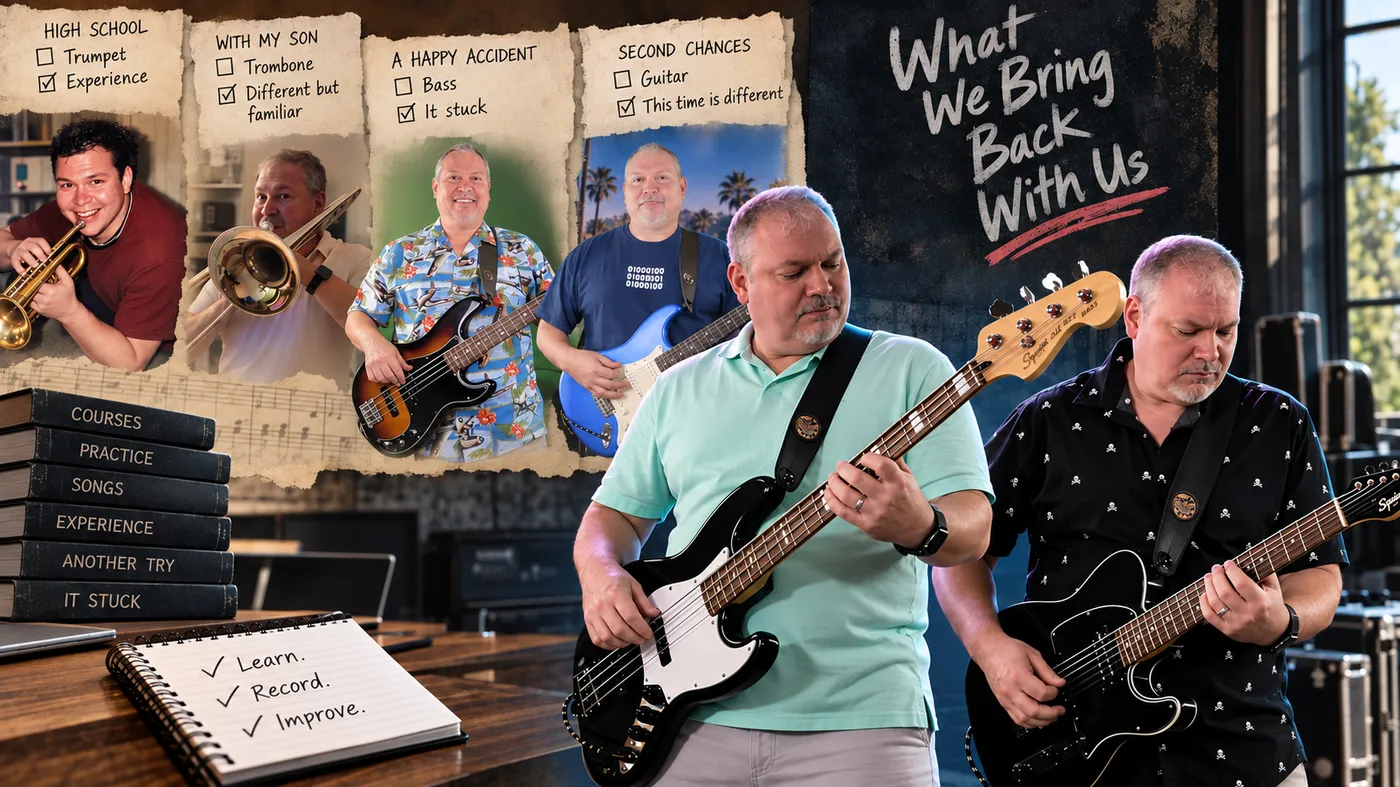
Bass itself had been something of a happy accident. But once I started imagining learning to play with my son, I also started imagining what being able to play might eventually look like.
“Substitute” made that short list because of the bass line. Glen Matlock’s part has a melodic independence that caught my attention long before I had the vocabulary to explain why.
At the time, “someday” was doing a lot of work.
I finally recorded it.
What I never imagined was that when the day came, I would also be recording the guitar parts.
Why This Time Was Different
This isn’t actually my first attempt at learning guitar.
I’ve tried before. It didn’t stick.
I also tried banjo at one point, with roughly the same result. Trombone went a little better, although that attempt came with an unusual instructor: my son.
I had played trumpet in high school, so some of the basic language of brass instruments was familiar. But trumpet and trombone are still different instruments, and there was another problem: I couldn’t read bass clef.
My teacher was not especially interested in waiting for me to figure that out.
In his defense, he was 11.
When I later started learning bass, bass clef became part of the process. My first course taught me the fundamentals. Afterward, I worked through a book course that taught me to sight-read it.
There’s a parallel there I didn’t notice until recently.
Trombone wasn’t my first brass instrument. Guitar isn’t my first string instrument. In both cases, enough of the foundation was familiar to make the new instrument feel a little less foreign.
But familiar isn’t the same as easy.
What was different this time was that bass had already taught me something none of those earlier attempts had.
It had taught me how I learn.
Learning How to Learn
When I started bass, I had a structured path through the fundamentals. Since then, I’ve had enough experience with courses, books, practice, and difficult songs to develop a much better sense of what works for me.
That matters more than I expected.
The first time I tried guitar, I was learning the instrument while also trying to figure out how to learn it.
This time, only one of those problems was new.
I still had to learn chord shapes, clean changes, muting, and everything else my hands didn’t know how to do. But awkwardness felt different once I had already experienced it on another instrument.
I knew that not being able to do something today didn’t necessarily say much about whether I would be able to do it later.
That may be the biggest reason this attempt stuck.
That growing understanding of how I learn is also part of what eventually led me to build Practice Studio.
Old knowledge keeps coming back. It just rarely comes back in exactly the form I left it.
Familiar, But Different
Some older musical experience has resurfaced too.
Trumpet put treble clef into my head a long time ago. Bass gave me bass clef. Now guitar has brought treble clef back into the picture.
Even that feels different.
With rhythm guitar, I’m often thinking less about individual notes and more about chords, shapes, rhythm, and harmonic movement. The notation may be familiar, but what I’m looking for in the music has changed.
Old knowledge keeps coming back.
It just rarely comes back in exactly the form I left it.
When Guitar Came Back to Bass
My first bass-and-guitar cover was Weezer’s “Beverly Hills.”
I’ve already written about one unexpected crossover from that recording: guitar practice made me more comfortable playing with a pick, and I brought that skill back to bass.
At the time, it felt like an interesting side effect.
Now it looks more like the beginning of a pattern.
Then Came “Substitute”
“Beverly Hills” and “Substitute” both use power chords on guitar, but the relationship between bass and guitar is very different.
On “Beverly Hills,” the two instruments spend much of the song supporting the same harmonic movement.
On “Substitute,” they have much more independence.
The rhythm guitar provides the drive and harmonic foundation while Matlock’s bass moves more melodically around it, almost like a countermelody.
That distinction matters because it’s what attracted me to the song in the first place.
Now, instead of only learning the bass line I had wanted to play for so long, I was learning what was happening on the other side of it too.
The guitar arrangement also asked more of me than “Beverly Hills.” One guitar track wasn’t enough for everything I wanted in the recording, so I ended up playing two.
For only my second guitar recording, that felt like a meaningful step.
More importantly, I had to understand how the parts fit together instead of treating the guitar as simply everything happening around the bass.
Then I picked up the bass and played something deliberately different against it.
My Ring Finger Apparently Got the Memo Too
There was another surprise waiting in the bass part.
When I first learned bass, I was taught one-finger-per-fret technique. After I started experiencing pain in my fretting hand, I learned a more Simandl-style approach and adopted it because it worked better for me.
I wasn’t looking to change that.
Guitar, however, asks much more of my ring finger through chord shapes and fretting. Somewhere along the way, that finger became more comfortable and independent.
While recording “Substitute,” I realized I was using it throughout the bass line.
I wasn’t deliberately switching back to one-finger-per-fret. I wasn’t trying to change my bass technique at all.
The finger was simply there when I needed it.
That may be my favorite example yet of guitar influencing my bass playing because I never intended for it to happen.
And it made me realize this wasn’t really just a story about bass and guitar.
Very Little Stays in Its Own Lane
For a long time, I thought about these musical experiences as separate things.
Trumpet was something I did in high school.
Trombone was something I tried with my son.
The first guitar attempt didn’t work out.
Bass became the instrument that finally stuck.
Then guitar became something new.
But they aren’t as separate as they looked.
Trumpet left some familiarity with treble clef behind. Trombone gave me experience approaching a related but different instrument. Learning bass eventually filled in the bass-clef gap that had frustrated that earlier attempt. Bass taught me how to approach learning an instrument successfully. Guitar made a pick feel more natural. Then it started changing what my fretting hand wanted to do on bass.
None of this followed a plan.
That may be the part I find most interesting.
We tend to think about learning music as a straight line: start at the beginning, acquire skills, get better.
My experience returning to music has looked nothing like that.
Some things moved forward. Some disappeared for years and came back. Some attempts seemed to go nowhere at the time but look different in hindsight. A new instrument strengthened something on an old one. Something I learned decades ago suddenly became useful again in a different context.
Very little stays in its own lane.
Sometimes learning something new wakes up something old.
Returning Isn’t Starting Over
It’s easy to think about returning to music in terms of what has been lost.
Maybe the reading isn’t as quick as it once was. Maybe the hands don’t remember. Maybe the instrument has been sitting in a case for years.
Or maybe a previous attempt never really got started at all.
It’s tempting to think of that as starting over.
I don’t see it that way anymore.
That doesn’t mean old skills are magically waiting exactly where we left them. Mine certainly weren’t.
But technique isn’t the only thing we bring back.
We bring experience.
Maybe we understand how we learn better than we did when we were younger. Maybe we’re more patient. Maybe we finally find the right teacher or the right way to practice. Maybe an unsuccessful attempt at one instrument leaves behind something that becomes useful years later.
And sometimes learning something new wakes up something old.
None of that removes the work.
It just means the starting line may not be where we thought it was.
The goal hadn’t changed. The musician who finally reached it had.
The Song I Wanted to Play Someday
Before my first bass arrived, “Substitute” was one of the songs I imagined playing someday.
The picture in my head was pretty simple: me, with a bass, finally able to play that line I had been listening to for years.
Someday finally arrived.
I did play the bass line.
But I also recorded two guitar tracks. I approached the song with skills and experiences I hadn’t collected yet when I first put it on that list. Even the way my hand moved around the bass had been influenced by an instrument I wasn’t planning to learn at the time.
The goal hadn’t changed.
The musician who finally reached it had.
I think that’s what makes finally playing “Substitute” feel like more than checking a song off a list.
When I started this journey, I was focused on everything I still had to learn. Looking back now, I’m more aware of everything that came with me—and everything I’ve picked up along the way.
Some of it came from successes. Some came from attempts that didn’t work out. Some of it sat unused for years before finding a place again.
It all accumulated.
Maybe that’s one of the things I like most about returning to music.
You still have to do the work. There’s no shortcut around that.
But returning doesn’t mean returning empty-handed.
And sometimes, when you finally reach one of those things you hoped you might be able to do someday, you discover that you brought far more with you than you realized.
Join the conversation
Comments
No comments yet. Start the conversation.