From the studio
Nearly Two Years Into Learning Bass, Here’s What I Didn’t Expect
Near the end of 2024, I bought a bass for my son.
I didn't buy it for myself.
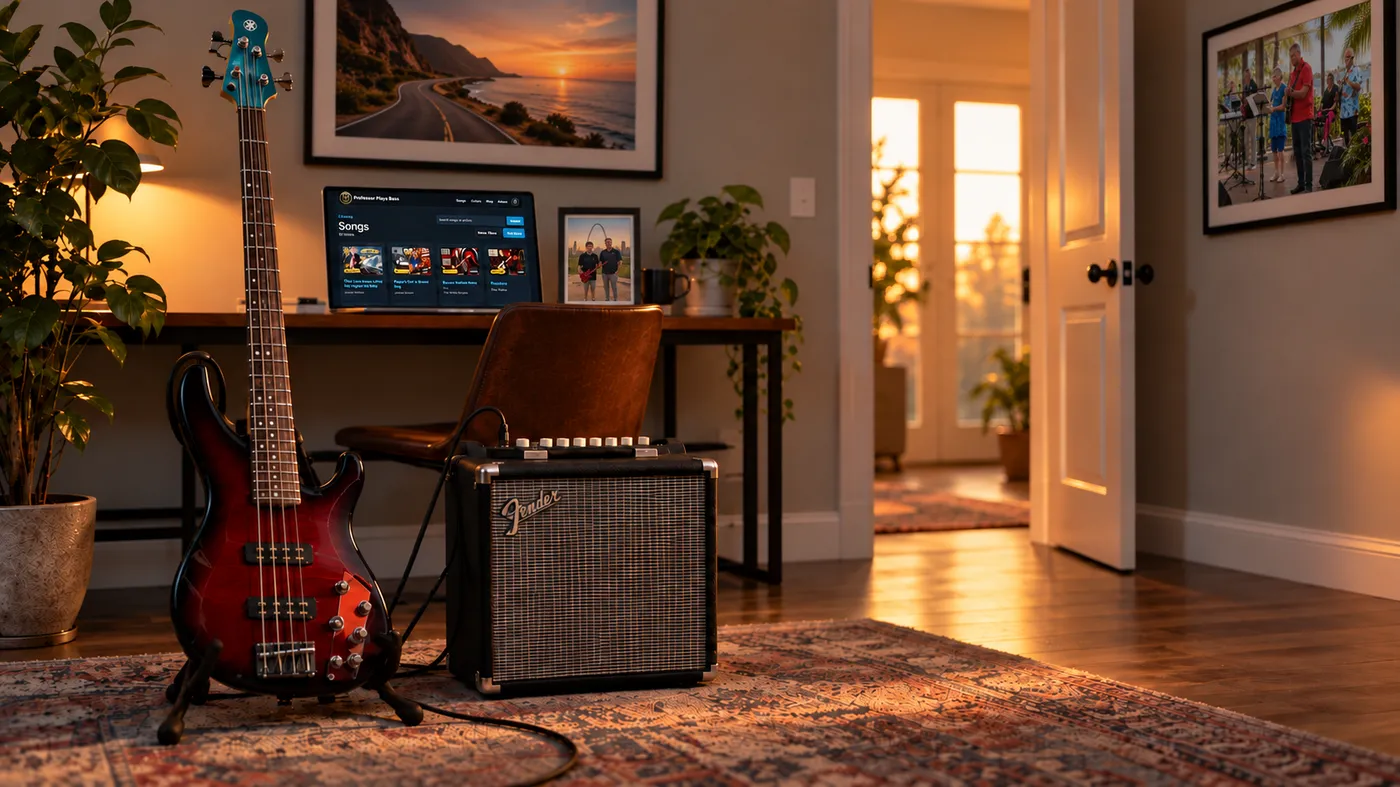
I bought my first bass for my son. Somewhere along the way, I started playing it too. Then I signed up for a beginner course, finished it, and kept going.
Nearly two years later, bass has become a much bigger part of my life than I ever expected.
Not because I’m trying to become a professional musician.
I’m not.
What surprised me is everything that happened around the playing: how I think about progress, how differently I hear music, how comfortable I’ve become being a beginner again, and how much creativity can grow out of something that doesn’t need to accomplish anything at all.
I thought I was learning to play bass.
Apparently, there was a little more to it than that.
Progress Looks Different From Inside the Journey
One of the strange things about learning something slowly is that progress can be difficult to see while it’s happening.
Day to day, it often doesn’t feel like much.
There’s always another song I can’t quite play. Another technique that feels awkward. Another passage that exposes something I haven’t figured out yet.
That makes it easy to concentrate on what still isn’t there.
But every once in a while, something provides perspective.
I’ll return to a song that once seemed impossible and realize it isn’t anymore. Something my hands had to think through deliberately has become automatic. I’ll hear something in a bass line that I wouldn’t have noticed six months earlier.
None of those moments arrives with much ceremony.
They just happen.
And I’ve realized that may be what real progress usually looks like from the inside. It isn’t a straight line and it rarely feels dramatic while you’re making it.
You spend a long time feeling as though you’re standing still.
Then you look backward.
And the distance is obvious.
The strange thing about learning slowly is that improvement often becomes invisible precisely because it has become normal.
Recording Changed the Way I Listen
Learning to play bass changed the way I hear bass.
Recording changed the way I hear everything else.
Once I started recording covers, listening became much more active. I began noticing how the bass works with the kick drum, where a player sits against the beat, how long notes are held, where space is left, and how small variations can change the feel of an entire section.
Songs I had heard for decades suddenly had details I had never really noticed.
And recording is unforgiving.
While you’re playing, something can feel pretty good. Play it back and the truth arrives immediately.
That note was early.
That one dragged.
That phrase was technically correct but somehow didn’t sit right.
That realization has probably done as much for my playing as anything else.
Recording also turned songs into something I could study. Instead of simply playing through them, I could listen back, compare takes, isolate problems and try again.
Eventually I built technology around that process, but the technology isn’t really the point.
The important part is what recording taught me to hear.
Now I can’t really turn that off.
And I’m glad I can’t.
Learning When to Stop Chasing the Whale
One song taught me another lesson entirely.
I spent nearly six months working on Jackie Wilson’s “(Your Love Keeps Lifting Me) Higher & Higher.”
It became my white whale.
I could play the notes.
Then I could play them better.
Then I could hear something else I wanted to fix.
There was always one more detail.
One more section.
One more reason to record it again.
Eventually, improvement stopped being the real problem.
Stopping was.
At some point, continuing to chase a theoretically perfect version wasn’t making the performance meaningfully better. It was just preventing me from calling it finished.
So I finally did.
The recording isn’t perfect.
It is finished.
I’m increasingly convinced those are two very different things.
There will always be something I could play better six months from now. That doesn’t make what I can play today invalid.
Sometimes progress means pushing a little longer.
Sometimes progress means knowing when you’ve caught enough of the whale to come home.
Being a Beginner Again Has Been Good for Me
There aren’t many things in my life anymore where I am unquestionably a beginner.
Bass gave me one.
There is something healthy about regularly attempting something you cannot yet do.
You can understand the concept completely and still have your hands refuse to cooperate.
You can practice something for days, think you finally have it, and discover the next morning that apparently you do not.
There are no shortcuts around that.
Experience elsewhere doesn’t grant you much immunity either. The instrument doesn’t care how long you’ve been doing anything else.
You have to be willing to sound bad before you sound better.
And strangely, I’ve come to enjoy that.
Being a beginner removes the expectation that I should already know the answer. It gives me permission to experiment, make mistakes, laugh at myself and try again.
That’s a surprisingly freeing place to spend some time.
The longer I play, the less interested I am in escaping beginner status as quickly as possible.
I’d rather remain curious.
There’s something freeing about having one part of your life where you’re allowed to be a beginner, make mistakes, laugh at yourself, and simply keep learning.
I Didn’t Expect Bass to Make Me This Creative
This may be the biggest surprise of all.
I expected bass to give me music.
I didn’t expect it to make me this creative.
At first, the goal was simple: learn some songs.
Then I started recording them.
Recording led to thinking about tone, arrangement, and how a song should feel—not just whether I was playing the right notes. Making videos added another layer. Suddenly I was thinking about how a song should look as well as sound.
Then I started writing about all of it.
Somewhere in there, I built software around the way I practice and record—not because I set out to build another project, but because one idea kept leading naturally to the next.
And then I helped write an original song with friends.
That one surprised me.
For most of this journey, I had been learning how to play music other people created. Writing something of our own felt like crossing into completely different territory.
Now guitar has entered the picture too.
I’m still very much learning, but the idea of eventually creating multitrack covers with bass and guitar already sounds like fun.
None of this was part of the plan when I picked up that first bass.
One thing simply led to another.
That may be what I like most about it.
There isn’t a roadmap.
I can follow whatever sounds interesting next.
A Hobby Doesn't Have to Lead Anywhere
That may also be one of the most important things bass has reminded me.
Not everything needs an objective.
It doesn’t have to become a side business.
It doesn’t have to produce an impressive result.
It doesn’t have to justify the time spent on it.
Sometimes playing bass is enough.
That sounds obvious, but I think adults can become remarkably good at turning things we enjoy into things we’re supposed to optimize.
I certainly can.
Bass has resisted that surprisingly well.
Yes, I track things. I record things. I built an entire application around practicing.
Apparently I am still me.
But underneath all of that is something much simpler:
I like playing bass.
Some evenings I practice because I’m trying to improve.
Sometimes I pick up a bass because there’s a song I want to learn.
And sometimes I play because playing is fun.
No larger purpose required.
Somewhere Along the Way, I Became a Bass Player
I’m still learning.
I still miss notes.
There are still songs that humble me almost immediately.
And there are bass players whose ability seems almost incomprehensible from where I’m standing.
But somewhere during these nearly two years, the language changed.
I stopped thinking of myself as someone who was trying to learn bass.
I play bass.
That doesn’t mean I’ve arrived anywhere.
If anything, the further I go, the more I realize how much there is left to learn.
But that’s no longer discouraging.
It’s part of the appeal.
I bought the first bass for my son.
I had no idea where that would lead.
Nearly two years later, I still don’t.
And I think that may be one of my favorite things about it.
Join the conversation
Comments
No comments yet. Start the conversation.