
From the studio
What’s in an Image? The Stories Behind Our Bass Cover Art
More Than a Thumbnail
What began as a solution for green-screen videos has become something much more personal. The images behind my bass covers now preserve memories, mark milestones and tell stories that the performance alone cannot.
They are also part of an ongoing collaboration with my son, who produces the videos. I may begin with the song, the bass and an idea, but we shape the finished presentation together. We consider how the image will support the performance, what details carry meaning and whether the concept still works once it moves from a thumbnail into the video itself.
The process usually starts with a photograph from the recording session. Generative AI helps us preserve the essential elements—me, the bass and the playing position—while imagining a different setting, wardrobe or visual era. The composition must work in a 16:9 frame, leave room for the green-screen performance and keep the title readable at thumbnail size. We often create a second version without the generated performer to use as the actual video backdrop.
The first result is rarely the last. Text moves, clothing changes and instruments occasionally become something they have never been before. Sometimes the unexpected details are the ones that make the image feel like ours. Occasionally a dog acquires space boots.
Three covers show how those ideas can grow into stories of their own.
“Money": The First Green Screen
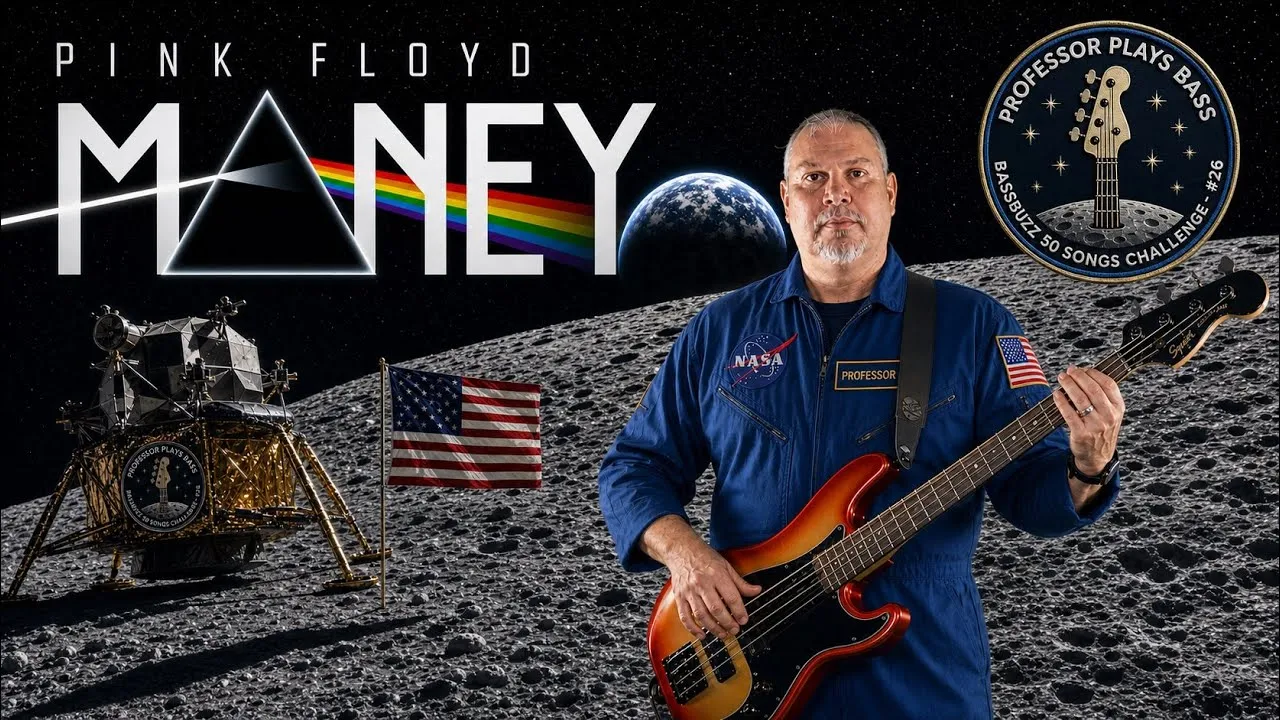
My cover of Pink Floyd’s “Money” was our first green-screen video. That makes it an important marker in the development of Professor Plays Bass. We were not simply creating another thumbnail; we were learning how to place a real performance convincingly inside an imagined world.
With the Artemis II lunar mission in the news, we combined space exploration with visual references to Pink Floyd. I was transformed into a bass-playing astronaut, complete with a NASA-style flight suit, lunar scenery and prism-and-spectrum imagery.
The concept became more personal through revision. The name patch on the flight suit was changed to “Professor,” and the mission emblem was redesigned for Professor Plays Bass. The channel name followed the top of the circular patch, while the bottom identified “Money” as song 26 in the BassBuzz 50 Songs Challenge. A stylized bass replaced the traditional mission symbol in the center.
That patch was created as a small detail for one video, but it did not remain there. Its circular design, channel name and central bass helped inspire the Professor Plays Bass logo. In other words, a fictional mission patch from our first green-screen experiment began shaping the identity of the larger project.
That feels appropriate in retrospect. The logo did not originate in a formal branding exercise. It emerged from something my son and I were already creating together. The patch captured much of what the channel had become: learning, experimenting, documenting progress and treating each song as its own small expedition.
The technology can render an image, but it does not know why the Gateway Arch matters, why the mission patch should carry a challenge number, or why the dog’s boots need to match mine.
The remaining revisions made the idea practical. We cleaned up artifacts in the curved lettering, removed a competing tagline and repositioned the song title and artist for YouTube. The lunar lander even received its own version of the mission emblem.
“Money” ultimately became more than a Pink Floyd-inspired moon scene. It marked our first green-screen production, documented my place in the challenge and planted the seed for the Professor Plays Bass visual identity.
“With or Without You”: A Spring Break Postcard
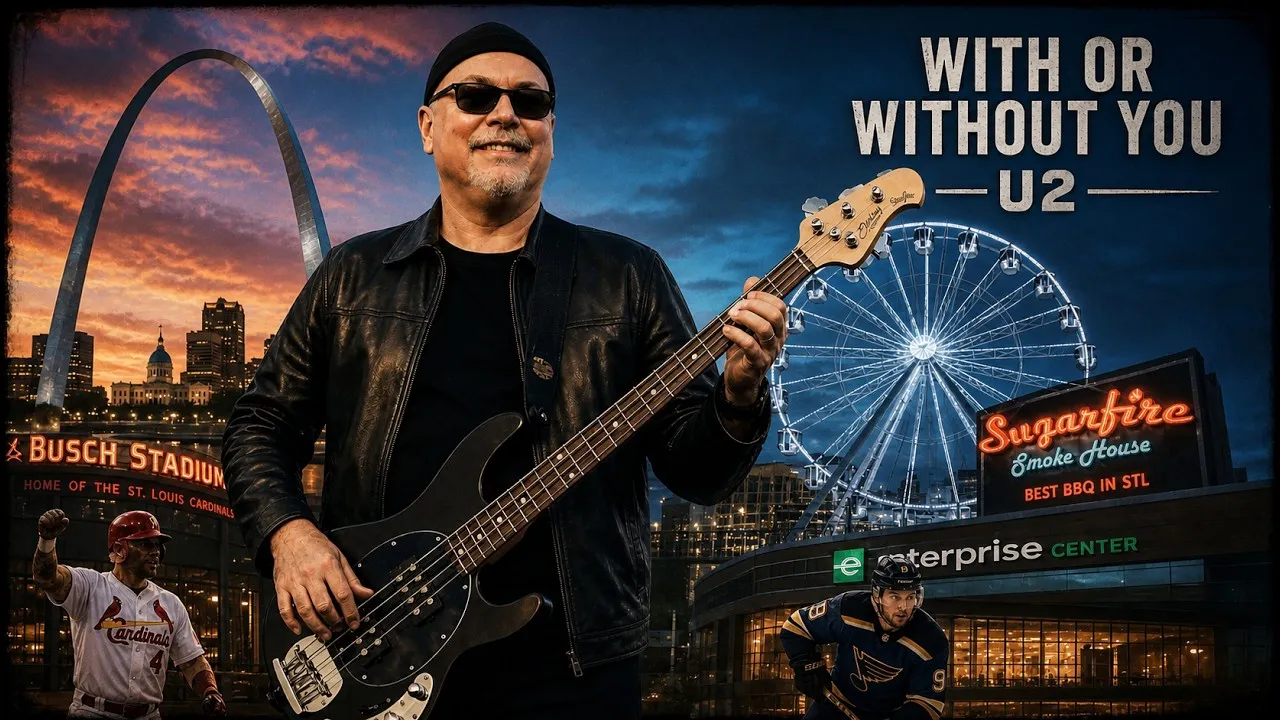
“With or Without You” began with a photograph taken during a spring break trip to St. Louis with my son. Because he also produces the videos, the trip and the cover became connected parts of the same experience.
We first gave the image the visual character of U2’s late-1980s period. The clothing, hat, sunglasses and photographic treatment were adjusted to evoke the era of the song. Headphones from the source photograph were removed, and the rough edges around the isolated subject were cleaned up.
Then we brought our trip into the scene. The finished image includes references to the Gateway Arch, baseball, hockey, barbecue and the city’s enormous Ferris wheel. Those details were not chosen merely because they identify St. Louis. They represent places we visited and things we experienced together.
That makes the image less of a collection of landmarks and more of a visual itinerary. It combines the atmosphere of U2’s song with a record of our spring break—part music tribute, part travelogue and part family photograph.
One of the final requests was simply to add a little color without changing the composition. That small adjustment kept the period mood while giving the thumbnail enough visual presence on screen.
This cover demonstrates what I find most appealing about the process. We could acknowledge the original artist without reproducing an album cover, then fill the scene with details that belong specifically to our version of the song. The world in the finished image never existed as pictured, but the memories inside it are real.
“Only Happy When It Rains”: A Futuristic Bass Finds Its World
The visual direction for “Only Happy When It Rains” began with the bass.
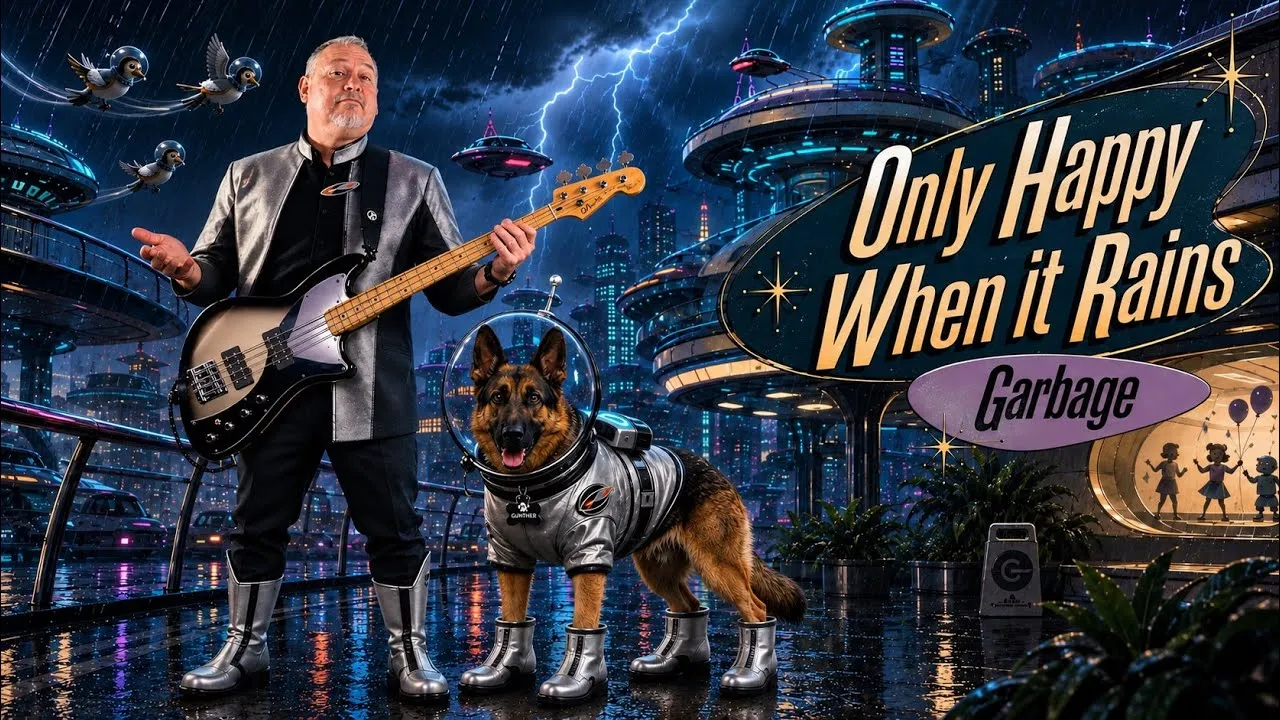
I had recently acquired a Fender Meteora, an instrument that manages to look vintage and futuristic at the same time. Its offset body feels as though it came from a future imagined decades ago. That retro-modern quality inspired the world we eventually built around it.
The first concept combined a realistic metropolitan rain scene with anime-style elements. I also wanted subtle references to the birds, wind, rain, thunder and children’s laughter heard at the beginning of the track. The idea was promising, but it had not yet found a unified visual language.
The Meteora pointed us toward a retro-futuristic world inspired by The Jetsons. Its bright, optimistic vision of tomorrow created an amusing contrast with the song: gloomy weather unfolding inside a colorful future designed by the past.
We experimented with the clothing colors, the balance between realism and animation and the placement of the title. The birds eventually received miniature space suits, because ordinary birds began to feel like a missed opportunity in a city like this.
The story became more personal when I added my dog and gave him the same futuristic treatment. Even his shoes required revision. They were changed to match my boots so he looked like my companion in the scene rather than a late addition.
That detail explains why my son and I enjoy this process. The Meteora inspired the setting, the song supplied the weather and our revisions gave the scene its personality. What might have remained a rainy futuristic city became a world occupied by space birds, a boot-wearing dog and a bass that looks completely at home there.
Giving an Idea a Visible Form
These three images share a production method, but they do not tell interchangeable stories. “Money” remembers our first green-screen experiment and contains the mission patch that helped inspire the Professor Plays Bass logo. “With or Without You” preserves a spring break trip and the places my son and I experienced together. “Only Happy When It Rains” builds an imagined retro-future around a new Fender Meteora, then fills it with increasingly personal details.
Generative AI has allowed me to participate more fully in that visual storytelling. I can imagine a lunar mission patch, a St. Louis memory recast in the world of U2 or a rainy future inspired by an unusually shaped bass. I do not need to be an illustrator or digital artist to begin exploring those ideas visually.
That does not make the creative process automatic. The technology can render an image, but it does not know why the Gateway Arch matters, why the mission patch should carry a challenge number or why the dog’s boots need to match mine. Those decisions come from experience, memory and conversation. The creative work lies in finding the story, communicating it, recognizing what the image gets right and continuing to shape what it does not.
The finished images are thumbnails, video backdrops and pieces of channel branding, but they are also records of the experiences surrounding each cover. The song supplies the starting point. The bass, the place and the moment supply the story. Generative AI helps us give that story a visible form, and the final image is something my son and I discover together.
Join the conversation
Comments
No comments yet. Start the conversation.