
From the studio
Let the Camera Roll
Recording Rancid's "Time Bomb"
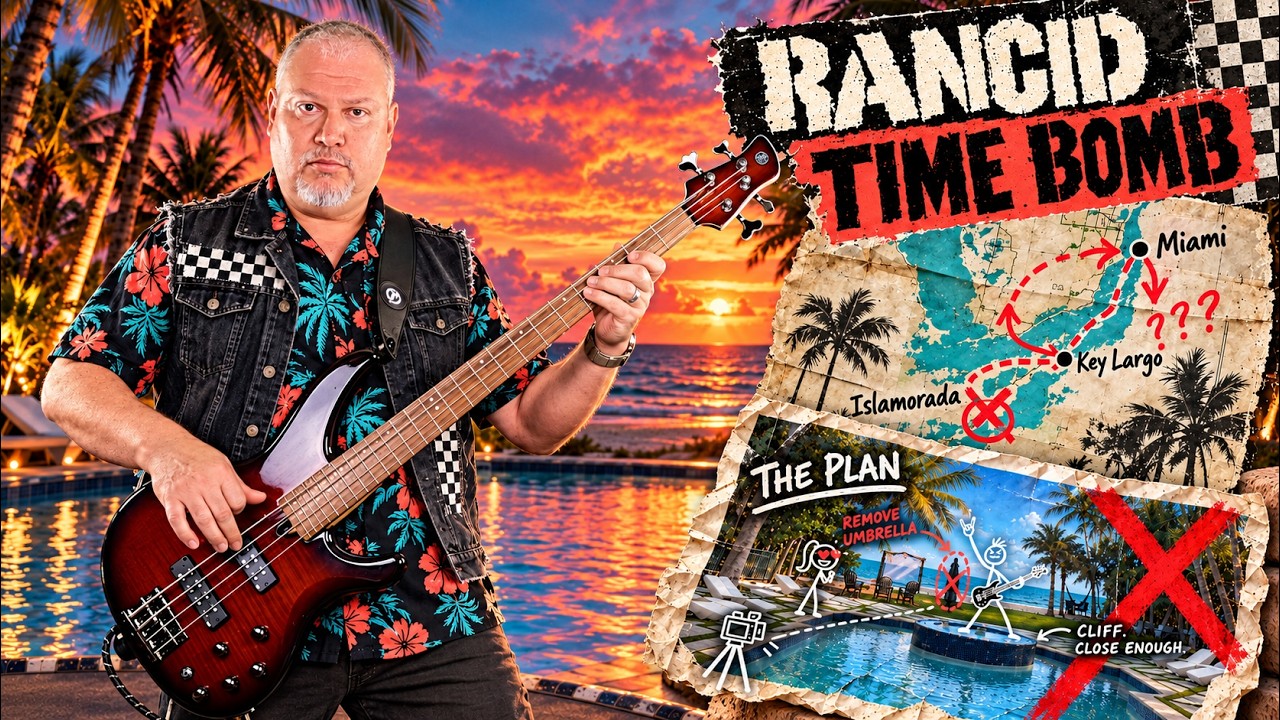
In my recent post, The Cabin Has Wi-Fi, I mentioned bringing a bass along on an upcoming trip to the Florida Keys.
The trip was to celebrate my wife's birthday, but we'd also talked about making a couple of music videos while we were there. She was even willing to help.
I had two ideas in mind: a laid-back beach performance of Jimmy Buffett's "Margaritaville" and something considerably more dramatic for Rancid's "Time Bomb."
And when I say dramatic, I mean rock-star dramatic.
The property had a swimming pool overlooking the Atlantic Ocean, with a circular hot tub elevated above the water. My plan was to move an umbrella out of the way, stand on the edge of the hot tub with my bass, and play "Time Bomb" with the ocean stretching out behind me.
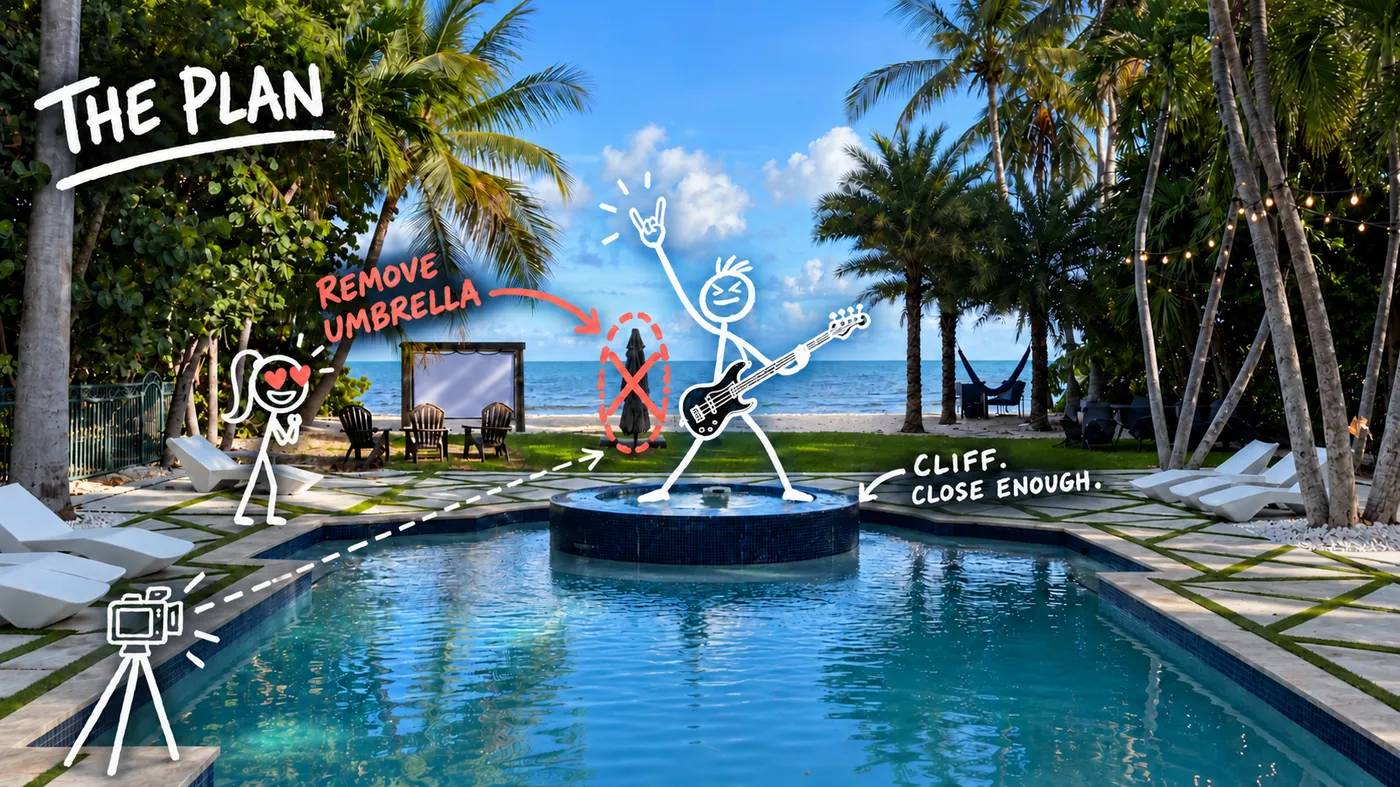
In my head, I was Slash standing on the edge of a cliff, delivering an epic guitar solo.
Except I was playing bass. And the song was ska-punk. And instead of a cliff, I had a hot tub.
Still, I thought it was going to be spectacular.
Unfortunately, things didn't go according to plan.
And neither did the recording.
Finding the Right Sound
"Time Bomb" is one of the fastest bass lines I've tackled since I started playing.
The song has a great ska-punk groove, but keeping up with it is another matter. The rapid eighth-note figures in the chorus are particularly demanding, and the real challenge isn't simply playing the notes. It's making them flow together smoothly at that speed.
I started learning the song on my Fender Jazz Bass, working through the basics before experimenting with different instruments and playing techniques.
First came the Sterling Ray34, which I tried playing with a pick. I wasn't particularly happy with the sound, so I switched to the Meteora. I tried that with a pick, then fingerstyle. Still not quite what I was looking for.
Then I noticed my old friend, the Yamaha TRBX604.
I picked it up, started playing, and liked what I heard.
Nothing particularly dramatic. It was simply the right tool for the job.
A later Producer Review from Practice Studio reinforced my impression that I'd found the right sound:
What is working
I hear a well-defined low-end presence in the isolated bass track, giving the part a supportive foundation. The Technical Review found a median pitch of around 73.5 Hz, which indicates stable fundamentals in a range typical for rock or punk-influenced lines. In the full mix, the bass cuts through enough to be perceptible without overpowering other instruments. This suggests the tone chosen is effective for the arrangement.
With the instrument question settled, I could concentrate on the more pressing problem: actually playing the song.
Less than a week after I started learning it, I'd recorded a complete bass track using the Yamaha.
I was reasonably happy with the result, but listening back revealed something I wanted to improve.
The bass line sounded choppy in places.
The notes were there, but they didn't always flow together the way I wanted. Some transitions felt abrupt, interrupting the rhythmic momentum that makes the song so much fun to play.
I even investigated whether compression might help smooth things out. Unfortunately, a compressor can only do so much when the problem is how the notes are being played.
What I really needed was more practice.
The Best-Laid Plans
That's where the Keys were supposed to come in.
I'd planned to spend some time working through the rough sections, concentrating on the transitions and trying to make the line more fluid. With a little luck, I'd come home with a better audio recording and the spectacular video I'd been imagining.
Instead, our plans changed, and the opportunity to practice and record in the Keys disappeared.
By the time I returned home, I still had my original bass recording, and very little time to decide what to do next.
I could postpone the project until I had another opportunity to work with the Yamaha. I could switch instruments and continue practicing toward another recording. Or I could accept the audio I'd already captured and move forward with the video.
Anyone who read about my experience recording Jackie Wilson's "(Your Love Keeps Lifting Me) Higher & Higher" knows that I can be pretty persistent when a song isn't cooperating.
That one became my white whale. I spent nearly five months working toward a performance I was willing to record.
I'm glad I stuck with it, but I wasn't particularly interested in repeating that experience with "Time Bomb."
I'd given myself a deadline for finishing this video, and I wanted to keep it.
So, with roughly ninety minutes to make something happen, I made my decision.
The original bass recording would be the one.
Now I just needed the video.
Just Enough to Get the Job Done
Over the past several months, my video recording setup has become increasingly elaborate.
Between the green screen, camera, audio interface, amp, and additional monitors that let me see what I'm doing while playing, getting everything ready can be a project in itself.
I didn't have time for all that.
I still used the green screen, but I skipped the amp and the additional monitors. I opened my laptop, connected the audio interface, and set up just enough equipment to capture the performance.
Nothing particularly fancy.
Just a bass, the equipment I needed, and a camera.
So I let the camera roll.
An Unexpected Encore
Of course, things couldn't go entirely smoothly.
Readers might remember my wife's spontaneous dance performance during the recording of "Seven Nation Army".
That little surprise brought my first video take to an abrupt end when I started laughing.
Apparently, she enjoyed the experience enough to request an encore.
There I was, working through the first video take of "Time Bomb," finally settling into the groove, when she appeared in front of me and started dancing like crazy.
Again.
She wasn't intentionally trying to stop the recording. She was just having fun.
Unfortunately, I started laughing.
And just like that, the first take was over.
I'll admit, I was simultaneously amused and a little grumpy. I was already working against the clock, and I really didn't have much time to spare.
But it's hard to stay annoyed with someone who's having that much fun while you're playing music.
We had a good laugh about it afterward.
Apparently, surprise dance performances are becoming a recurring feature of Professor Plays Bass.
I'm beginning to wonder whether I should start including them in the production schedule.
Not Quite What I Imagined
I had pretty high hopes for "Time Bomb."
I wanted more time to practice. I wanted another opportunity to record a smoother bass line. And I really wanted that ridiculous rock-star moment overlooking the Atlantic.
None of those things happened the way I'd planned.
Instead, I recorded the video at home using the bass track I'd captured after just six days of working on the song.
And I'm happy with the recording.
I can still hear the rough spots. Given another week of practice, I think I could have improved the fluidity of the bass line. But the recording captures what I could play at that point, and I'm comfortable letting that stand.
I kept the deadline I'd set for myself.
Mostly, I was relieved.
But there was one part of the plan I wasn't quite ready to give up.
With a little green-screen magic, we created a virtual stage overlooking the ocean, complete with palm trees, a spectacular sunset, and a rather conspicuous reminder of the original plan that never happened.
So I won't be standing on the edge of a real hot tub overlooking the Atlantic.
But it looks like I'll get my Slash-on-a-cliff moment after all.
And my wife? She already had her encore.
Join the conversation
Comments
No comments yet. Start the conversation.